What Is FTE? Full-Time Equivalent Meaning & How to Calculate It

In the modern workplace, understanding your Full-Time Equivalent (FTE) is essential for both employees and employers. FTE helps businesses standardize working hours, calculate proportional salaries, and plan workforce resources efficiently. For employees, knowing FTE ensures fair pay when working part-time, term-time, or in shared roles.
This guide explains what FTE is, why it matters, and how to calculate FTE salary in the UK, including examples and practical scenarios.
What Does FTE Mean?
FTE (Full-Time Equivalent) is a standard measurement that converts part-time or variable-hour work into an equivalent full-time workload. Essentially, it answers the question: “How many full-time employees would it take to cover these hours?”
For example:
- One full-time employee working 40 hours per week = 1.0 FTE
- Two employees each working 20 hours per week = 1.0 FTE (combined)
- An employee working 30 hours per week in a 40-hour system = 0.75 FTE
FTE is commonly used in:
- Payroll and salary planning
- Budgeting for HR and workforce management
- Comparing part-time and full-time roles fairly
Why FTE Matters for Salary Calculation
Understanding FTE is crucial for calculating proportional salaries. When employees work less than full-time hours, their salary is adjusted based on their FTE.
Example:
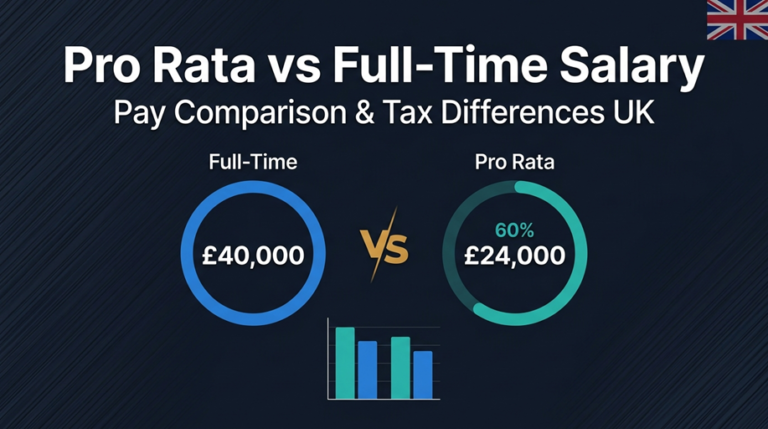
- Full-time salary: £40,000 per year
- Employee FTE: 0.6 (24 hours out of 40)
- FTE salary: £40,000 × 0.6 = £24,000 per year
This ensures employees are paid proportionally to the hours they work while maintaining clarity and fairness in HR policies.
How to Calculate FTE Salary in the UK
Calculating FTE salary is straightforward:
FTE Salary = Full-Time Salary × (Employee Hours ÷ Full-Time Hours)
Step-by-Step Example
- Identify the full-time salary: £36,000 per year
- Determine standard full-time hours: 37.5 hours/week
- Identify your part-time hours: 22.5 hours/week
- Apply the formula:
FTE Salary = £36,000 × (22.5 ÷ 37.5) = £21,600 per year
This formula can also be applied to monthly, weekly, or daily salary calculations, making it flexible for payroll purposes.
Practical Considerations
- Term-Time Contracts: Employees working only during school terms will have their FTE adjusted to reflect the actual months worked.
- Job Shares: Two employees sharing one full-time role each receive a portion of the full-time salary based on their hours.
- Shift Work: FTE allows for fair comparison between employees with variable schedules.
Benefits of Understanding FTE for Businesses
- Accurate Payroll Management: FTE simplifies salary calculations, reducing errors and ensuring fairness.
- Resource Planning: Managers can calculate how many full-time employees are effectively working across different part-time roles.
- Budget Forecasting: FTE helps businesses predict staffing costs more accurately.
- Compliance: UK employment law requires proportional pay and holiday entitlement; FTE makes it easier to comply.
FTE vs Pro Rata: Understanding the Difference
Many people confuse FTE with pro rata, but they are slightly different:
- FTE measures hours worked relative to full-time hours (focuses on workload).
- Pro Rata measures salary or benefits relative to FTE (focuses on pay).
Example:
- Employee works 24/40 hours → 0.6 FTE
- Full-time salary = £40,000
- Pro rata pay = £40,000 × 0.6 = £24,000
In short, FTE is the metric, while pro rata is the application to pay and benefits.
FTE Calculators in the UK
To simplify calculations, many businesses and employees use FTE salary calculators UK. These online tools allow users to:
- Convert full-time salaries to part-time equivalents instantly
- Include term-time or variable-hour contracts
- Calculate gross-to-net pay for take-home salary estimates
- Determine daily and hourly rates for contractors or shift workers
Using a calculator ensures accuracy, speed, and clarity—especially for HR teams managing multiple employees.
Examples of FTE in Real-World Scenarios
1. Part-Time Office Worker
- Full-time salary: £32,000
- Full-time hours: 37.5/week
- Part-time hours: 22.5/week
FTE: 0.6 → Salary: £19,200 per year
2. Term-Time Teacher
- Full-time salary: £30,000
- Full-time months: 12
- Term-time months: 9
FTE: 0.75 → Salary: £22,500 per year
3. Job Share
- Full-time salary: £45,000
- Each employee works 50% of hours
FTE: 0.5 → Salary per employee: £22,500 per year
These examples highlight the flexibility of FTE in ensuring fair and proportional compensation.
Tips for Employees
- Always check your employment contract for full-time hours and salary.
- Use an FTE salary calculator UK for quick and accurate estimates.
- Understand how your holiday entitlement and benefits may be adjusted proportionally.
- Keep track of hours worked if you have variable schedules, to ensure accurate pay.
Common Questions About FTE
1. Is FTE only used for salary?
No. FTE is also used to calculate holiday entitlement, pension contributions, and other benefits proportionally.
2. Can FTE apply to contractors?
Yes. Contractors working variable hours can use FTE to calculate hourly or daily pay relative to a standard full-time role.
3. How does FTE affect tax?
FTE affects gross pay, which in turn determines income tax in the UK.
4. Are part-time employees always paid pro rata?
Yes. In the UK, part-time workers must be paid proportionally to their FTE, ensuring fair compensation under employment law.
Key Takeaways
- FTE (Full-Time Equivalent) is a standardised way to measure part-time or variable-hour work against full-time hours.
- It is essential for accurate salary calculation, HR planning, and budgeting.
- Use the FTE formula or a reliable FTE salary calculator UK to convert full-time pay to part-time equivalents.
- FTE ensures fairness, transparency, and compliance with UK employment regulations.
Understanding FTE is crucial for both businesses and employees. Whether you are managing HR payroll, negotiating a part-time contract, or calculating term-time salaries, knowing how to calculate your FTE salary helps make informed decisions and ensures fair compensation.